
Criminal Court Cases in Caldwell County
Caldwell County criminal cases use North Carolina's unified General Court of Justice. District Court resolves misdemeanors and handles initial felony proceedings, including first appearances and probable-cause stages. A felony that advances for trial moves to Superior Court, often after a grand jury returns an indictment. There is no separate municipal criminal court in Lenoir, Granite Falls, or Hudson. City charges enter the same county court system.
The elected Clerk of Superior Court keeps the files for both trial divisions. The Judicial Branch also explains the Portal, public-terminal, paper-file, and copy routes in its court-record access instructions. Caldwell County is part of Prosecutorial District 36, Superior Court District 36, and District Court District 36. The clerk record is the best source for the charge as filed, later court events, a plea or trial outcome, and any sentence. Police narratives and jail booking entries remain with other custodians.
Caldwell County Criminal Cases Change Courts
A felony arrest may first appear on a District Court calendar even though Superior Court is the felony trial court. That is not a mismatch. District Court handles early felony steps, while the district attorney decides how the prosecution proceeds. An indictment can then move the felony into Superior Court. Misdemeanors generally stay in District Court.
Use the case number, charge text, division, and event log together. A `CR` case number means the matter contains a criminal offense, but it does not by itself say felony or misdemeanor. The charge and current court stage provide that answer. An initial allegation can also be amended, dismissed, or resolved through a different charge, so the newest disposition matters more than the first booking label.
Note: A complainant may provide information, but only the prosecutor or judge can dismiss a pending Caldwell County criminal charge.
Caldwell County Case Record Searches
The North Carolina eCourts Portal gives free public access to Caldwell County case summaries. The Judicial Branch's eCourts program page documents the statewide Enterprise Justice system. Anonymous users can search without registering. A free account can save matters in My Cases, but it does not unlock confidential records. The Judicial Branch recommends Chrome or Edge and suggests clearing the browser cache when Portal controls fail.
- Open Smart Search and enter a party name or a formatted case number.
- Open Advanced Filtering Options and choose Caldwell County as the location.
- Select Criminal Actions, then narrow by filing dates, status, or date of birth when known.
- Review Case Information, Parties, Events, Dispositions, Hearings, and any public document images.
- Compare Judgment Search, then ask the Caldwell County clerk for an official or certified copy.
The official Portal search controls support both broad leads and exact checks. Wildcards can help with spelling variants, but a date of birth is the stronger way to separate people who share a name.
| Portal field | Type | Required | Caldwell search use |
|---|---|---|---|
| Smart Search | Text | Unspecified | Party name or case number; supports official wildcard rules |
| Location | Filter | No | Select Caldwell County |
| Date of birth | Date | No | Helps distinguish a person from similar names |
| Case type | Filter | No | Choose Criminal Actions |
| Filing date | Date range | No | Narrows the filing window |
| Search Hearings | Alternate search | No | Uses case, party, attorney, officer, or courtroom details |
| NC Judgment Search | Alternate search | No | Filters judgments by party, case, location, status, or date |
Caldwell County Clerk Certified Case Searches
Portal is not a certified background check. For a certified, name-based search of Caldwell County court records, submit Form AOC-CR-314 to the Clerk of Superior Court. The fee is $25. An in-person request may be paid by credit card, cash, money order, or certified check. A mailed request uses a money order or certified check, not a personal check.
The form asks for the county, searched name, date of birth for an individual, race, sex, search scope, date range, and requester contact details. These identity fields reduce false matches. The product covers one county and uses court records, so it is not the same as the fingerprint-supported statewide record held by NCSBI.
Caldwell County Clerk of Superior Court
216 Main Street NW
Lenoir, NC 28645
828-759-3500
Monday through Friday, 8:00 a.m. to 5:00 p.m.
The Judicial Branch's Caldwell County contact directory also lists the district attorney, magistrates, and trial judges. The separate Caldwell County payment page covers court-payment channels. Use each page for its stated task without treating those offices or payment tools as alternate custodians for the clerk's case file.
What a Criminal Case File Contains
A public Caldwell County case summary can show the prosecution from filing through outcome. Portal groups data into case information, assignments, parties, causes where applicable, events, dispositions, hearings, financial information, and eligible images. It does not show a full investigative file. Social Security numbers are not displayed, and only public, unsealed, unrestricted images appear.
| Case number and status | Identifies the matter, filing year, case type, sequence, county code, and current state. |
|---|---|
| Charge or cause | Shows the filed allegation, which may differ from the first arrest label. |
| Parties and counsel | Lists public party and attorney information tied to the case. |
| Register of actions | Provides the chronological event log for filings and court activity. |
| Hearings | Lists scheduled and past court events when publicly available. |
| Disposition and judgment | Shows whether a charge ended in dismissal, acquittal, conviction, or another outcome. |
| Sentence and finances | May show the ordered sentence and reference-only financial data, not a current payoff. |
Use the disposition beside each charge, not merely the overall case status. One Caldwell County file can contain more than one count, and the counts may end in different ways. Judgment Search can add disposition status, index timing, parties, and comments, while the register of actions supplies the event sequence.
Read Caldwell County Criminal Case Numbers
North Carolina Enterprise Justice numbers follow a set pattern. In the example `21CR000003-910`, the first two digits are the year, `CR` is the case type, six digits form the sequence, and the last three digits are the county identifier. An `IF` file is infraction-only. A `CR` file can contain either a felony or misdemeanor, so read the charge and division before drawing a conclusion.
- Disposition
- The result of a charge, such as dismissal, acquittal, or conviction.
- Register of actions
- The dated list of filings, hearings, and other case events.
- Indictment
- A grand-jury accusation that supports felony prosecution in Superior Court.
- Arraignment
- The stage at which the defendant formally responds to a charge.
- Recognizance
- Release based on a promise and conditions rather than secured money.
Converted events from the system used before Odyssey may display 12:00 a.m. That time can be a conversion artifact, not the true hour of a Caldwell County court event. Check nearby docket entries or ask the clerk when timing matters.
Criminal Case Stages in Caldwell County
A criminal file may begin with a citation, summons, or arrest. A judicial official addresses initial process and release terms where needed. District Court then resolves a misdemeanor or handles the preliminary steps in a felony. The district attorney controls the prosecution. A felony may move by indictment to Superior Court, where a plea or trial leads to disposition and, after conviction, sentencing.
Case flow: Charges Filed → Arraignment → Pretrial → Plea or Trial → Disposition → Sentencing
The sequence helps explain why one Caldwell County search can show a hearing but no final result. It also shows why an arrest record cannot supply the answer. The later case file records amendments, motions, pleas, findings, and judgment. Readers tracing the first custody event can use the separate Caldwell County arrest search, then return to the clerk record for the filed prosecution.
Missing Caldwell County Cases Need the Clerk
A blank Portal result does not prove that no Caldwell County case exists. A spelling error, a common name, the wrong county filter, an older paper file, restricted access, expunction, or data conversion can all affect the result. Start by changing the search fields. Then use a public access computer at the Caldwell County Courthouse.
The courthouse terminal is free and can search criminal records by defendant name, case number, or victim and witness name. Users may view or email non-certified records without charge. Ask the clerk for the paper file or a certified copy when the terminal only supplies an index. The office can also explain the copy route, though the reviewed official source did not state an ordinary copy or certification fee.
Note: Sealed, expunged, juvenile, and otherwise confidential matters will not become public merely because a request is made in person.
Caldwell County Federal Criminal Case Records
Federal prosecutions involving Caldwell County do not appear as county Superior Court cases. Caldwell County lies in the Statesville Division of the U.S. District Court for the Western District of North Carolina. PACER is the official federal docket and document channel, and its published fee schedule governs electronic access charges. The Statesville clerk's office provides the court counter.
The official Statesville federal court page shows the courthouse that serves Caldwell County. The image below comes from that government source.
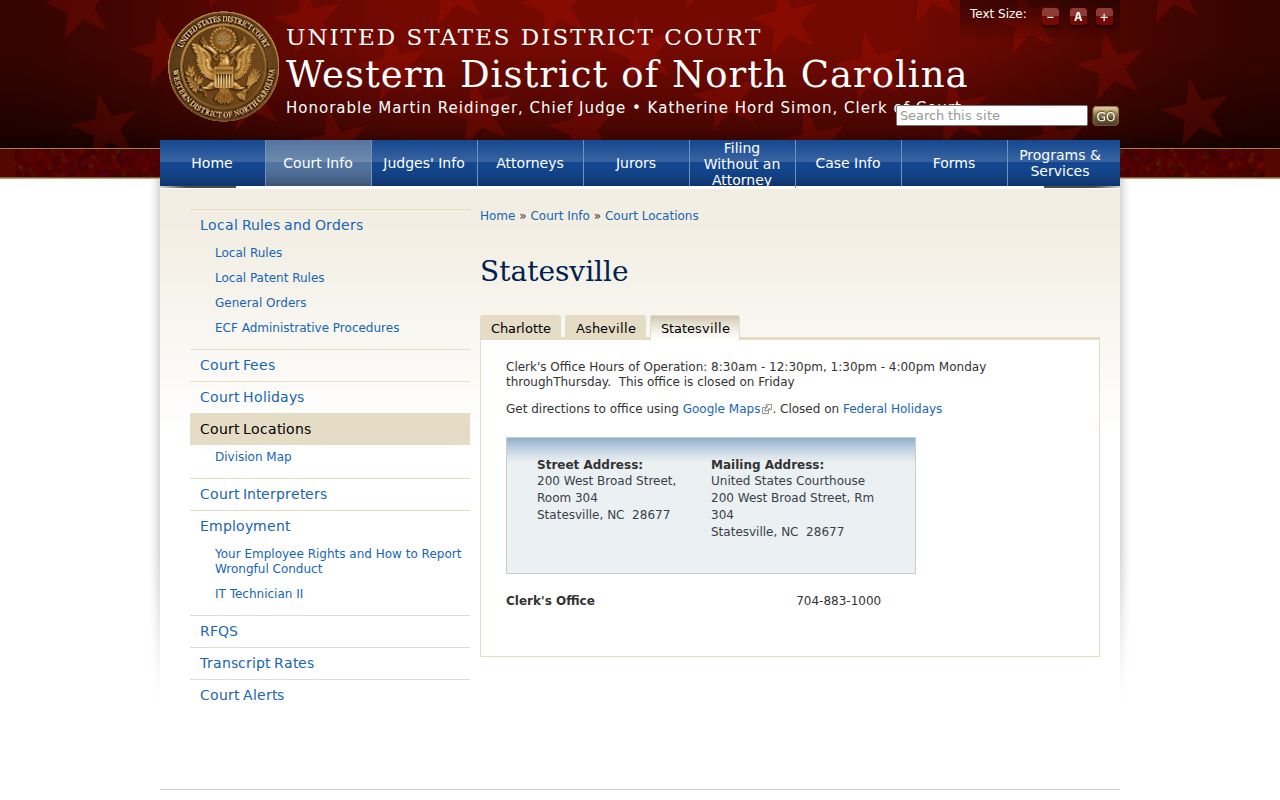
This separate building and docket system show why a county eCourts search cannot answer a federal case question. Use PACER or the federal clerk for those records.
Access Rules for Case Records
G.S. 7A-109 makes clerk records open during regular hours unless another law restricts access. Public availability does not mean every document is online. Portal images appear only when they are public, nonconfidential, unsealed, and unrestricted. Paper records may remain at the clerk's office even when no image is shown.
Juvenile cases, protective orders, unreturned warrants, and sealed or expunged matters have special limits. Personal identifiers are also withheld. North Carolina's Public Records Law treats law-enforcement investigative files differently from judicial case files. A Caldwell County court record may disclose the filed charge and outcome while the police agency lawfully withholds witness statements, photographs, or investigative attachments.